
Failure Tolerance
On Endurance and Structural Decay

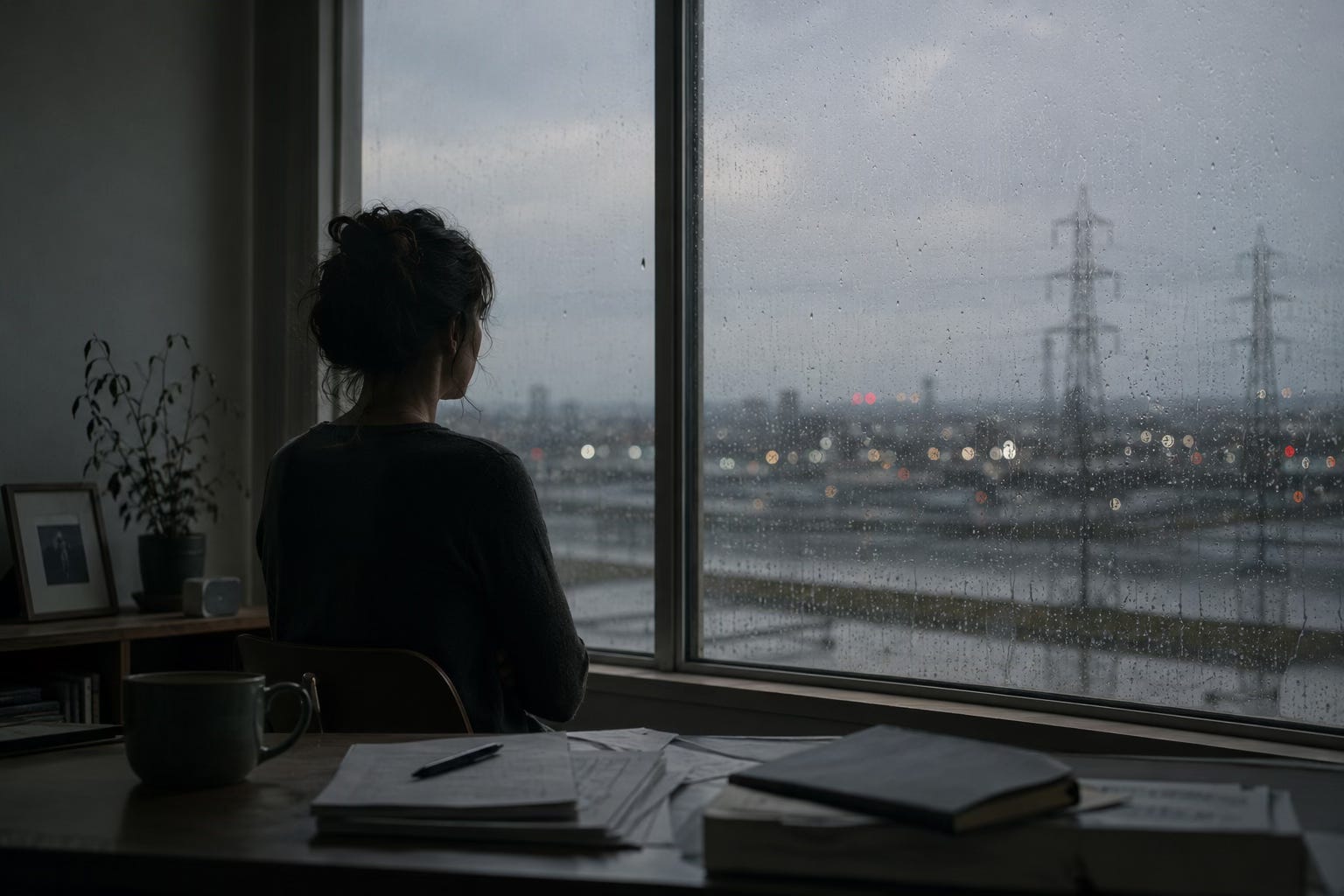
The first indication was the smell.
Not smoke. Not insulation. Not the hot-metal tang that came after a transformer failure or a bus differential event. Something wetter than that. Damp carpet left sealed too long. Boiled cabbage. The odor had drifted under the control room door around three in the morning and settled into the fabric chairs while the operators sat under fluorescent light pretending not to notice it.
Myra logged the timestamp automatically.
03:12. Peripheral environmental anomaly. No source identified.
Her fingers moved before thought did. Years of repetition. The keyboard greasy from disinfectant wipes and human skin oils baked together by dry conditioned air. The grid map spread across six monitors in front of her. Transmission corridors rendered in pale green. Substations in white squares. Active alarms flashing amber along the western coastal line where salt contamination had caused tracking faults all week.
Beside her, Colin was chewing antacids again.
“You smell that?” he asked.
Myra zoomed into the 275kV interconnector loading chart without looking at him. “Probably the drains.”
“Doesn’t smell like drains.”
“No.”
A pause.
Then the familiar sounds resumed. Mouse clicks. Chair hydraulics sighing. The thin electronic chirp every time SCADA refreshed an alert status. Somewhere deeper in the building a printer began spitting out overnight dispatch sheets with mechanical aggression.
On monitor four, the Murray corridor demand curve steepened unexpectedly.
Myra straightened.
“There,” she said.
Colin leaned across. “That’s not weather-related.”
“No.”
She opened the contingency analysis suite. N-1 reliability simulations populated the screen. Hundreds of scenarios processed in rapid succession. Line trips. Generator separations. Cascading load shedding sequences. Black-start viability. The software rendered possible disaster in clean blue tables.
She trusted tables.
Tables behaved.
At 03:24 the phone rang.
Not the external line. Internal operations priority.
Myra lifted the receiver immediately.
“Control.”
Static first. Then a voice from Field Operations North.
“We’ve got audible discharge at Corrowa switching yard. Moisture ingress looks worse than expected.”
“How many insulators tracking?”
“Eight visibly compromised. Maybe more after daylight.”
“Transformer temperature?”
“Rising slowly.”
Myra watched numbers populate remotely on her monitor. Oil temperature. Load current. Reactive compensation.
“How long before failure risk?”
The field operator hesitated. People always hesitated before giving numbers that might later become evidence.
“Hard to say.”
“You already estimated.”
Another pause.
“Two hours maybe.”
“Okay.”
She hung up.
No drama. No raised voice. Just procedure.
She opened the load redistribution protocol while Colin contacted market dispatch to arrange partial transfer capacity. Around them the control room continued under the deadened fatigue peculiar to places operating twenty-four hours a day. No windows. No weather. Human bodies managed like equipment assets rotating through scheduled maintenance.
Myra rubbed beneath one eye.
Too much dryness. Too little sleep.
On the far wall a television silently displayed flood footage from the north coast. Muddy water carrying wheelie bins through suburban intersections. A reporter standing ankle-deep in brown runoff speaking urgently into a microphone while captions scrolled beneath her.
INFRASTRUCTURE UNDER PRESSURE.
Everything was under pressure.
At 05:10 they executed controlled load reduction across two industrial sectors to preserve system stability. Myra dictated switching instructions carefully, one hand pressed against the base of her throat.
“Open breaker seven-forty-two at Redbank.”
Click.
“Confirm open.”
“Confirmed.”
“Close bypass isolator.”
“Confirmed.”
Her voice never changed. Graduate operators used to find that calming. Senior management called her dependable during failure events. During the Brisbane storm collapse three summers earlier she had coordinated rolling outages for nineteen straight hours without once leaving the control desk except to urinate.
Afterward, a journalist described the event response as “remarkably composed.”
Myra had clipped the article without knowing why.
By seven the smell had worsened.
Not drains after all.
Something organic.
Colin finally stood and walked toward the kitchenette. A minute later he called out quietly.
“Oh Christ.”
Myra followed.
The refrigerator door stood open. Inside, beneath cartons of expired milk and someone’s forgotten yogurt containers, sat a plastic meal-prep box swollen tight with decomposition gases. Lentils maybe. Rice. Green fur blooming beneath condensation.
Colin pinched his nose. “How long’s that been there?”
Myra checked the label.
February.
No one laughed.
He carried the container toward the bin room using both hands like hazardous material. Myra washed her palms afterward although she had not touched it.
Back at the console she noticed three missed calls on her mobile.
Home.
She stared at the screen for several seconds before silencing notifications completely.
At 08:42 Corrowa transformer protection tripped.
The failure arrived with almost disappointing simplicity. One second stable. The next, gone. Alarms flooded the interface in dense amber clusters. Power rerouted automatically across stressed transmission paths while frequency oscillations rippled through the southern network.
Myra began issuing commands.
“Redispatch gas peakers.”
“Curtail industrial interruptibles.”
“Monitor voltage collapse risk along Riverina.”
No panic. Only sequence.
Her headset pressed hard against her hairline. Sweat gathered beneath her collar despite the cold room. Numbers moved. Stabilized. Drifted again.
Across the desk Colin muttered, “Come on.”
Myra watched the interconnector loading hold barely below emergency threshold.
98%.
98.4%.
98.7%.
Then slowly downward.
The room exhaled.
Someone behind her laughed once from pure exhaustion.
By midday the event had been downgraded from critical to contained. Reports would follow. Root-cause analysis. Asset review. Regulatory correspondence. Insurance complications. There would be meetings for months.
Myra completed the preliminary incident chronology in forty-three minutes.
At the bottom she typed:
No preventable operator error identified.
Then she sat motionless for a while.
Her phone vibrated again.
This time she answered.
“Yes.”
Silence first. Breathing.
Then Daniel said, “You forgot.”
She closed her eyes briefly.
“What time is it there?”
A brittle laugh.
“At home? Same time as everywhere else.”
Myra checked the operations floor clock automatically though she already knew. 13:16.
“I’m still at work.”
“You said you’d come by lunch.”
“I know.”
Another silence.
She could picture him standing in the kitchen with one hand on the bench edge because lately he leaned against things constantly, as though balance required conscious effort now.
“It’s fine,” he said.
Which meant it was not.
“How did the appointment go?”
The refrigerator compressor hummed nearby. Someone in the control room coughed repeatedly into a sleeve.
Daniel spoke carefully. “They increased the dosage again.”
“Okay.”
“That’s all?”
“What did the specialist say exactly?”
“He said exactly what the specialist said last month.”
Myra reached for a pen although she had nothing to write.
“Did he mention cognitive response metrics?”
“No.”
“Mobility decline projections?”
“No.”
“He should have.”
“He didn’t.”
Her grip tightened around the pen until her knuckles whitened.
“Daniel—”
“You always do this.”
The sentence arrived quietly. Worse that way.
“I’m trying to understand the progression.”
“You’re trying to turn it into a systems report.”
“That’s not fair.”
“It’s accurate.”
Behind her, another operator asked whether she was free for post-event debrief in conference room three. Myra lifted one finger without turning.
Daniel said, “Don’t come home early. There’s no point.”
Then the line disconnected.
Myra remained seated with the dead phone against her ear several seconds longer than necessary.
Afterward she entered conference room three carrying a stack of printouts.
No one mentioned the shadows beneath her eyes. In infrastructure industries exhaustion was treated as evidence of seriousness. The room smelled faintly of whiteboard marker and burnt coffee. On the projector screen a frozen network diagram displayed the morning’s outage propagation sequence in branching red lines that resembled vascular tissue.
Myra began speaking.
“At 08:42:16 transformer differential protection activated following sustained insulation breakdown likely associated with moisture contamination. Automatic isolation proceeded within expected tolerances…”
The others nodded.
Pens moved.
Questions followed. Technical. Contained. Solvable.
By late afternoon rain had started again.
Myra drove home through low industrial suburbs where floodwater still sat trapped along gutters in opaque brown sheets. The radio delivered traffic reports and political arguments in alternating bursts. She turned it off at the first mention of healthcare funding.
The house appeared unchanged from outside.
Single-storey brick. Damp jacaranda leaves collecting against the front step. One kitchen light on despite daylight. Nothing dramatic. No visible evidence of collapse.
Inside, the air carried stale heat and pharmaceutical sweetness.
Daniel was asleep on the couch beneath a blanket despite the humidity. One arm hanging downward. Fingers twitching occasionally.
The television played silently.
Myra stood in the doorway removing her shoes.
The house had become quieter over recent months in incremental ways difficult to track individually. Fewer cupboards closing. Fewer conversations from separate rooms. Music disappeared first. Then cooking. Then incidental touch. Human noise reduced gradually until the place resembled a waiting area after visiting hours.
She picked up a mug from the coffee table.
Cold tea.
A skin formed across the surface.
Beside it sat Daniel’s medication organizer. Monday through Sunday compartments. Transparent plastic. Tuesday evening empty already.
Myra checked the dosage labels automatically.
Two missing.
Not one.
Daniel opened his eyes without moving his head.
“You’re auditing me now?”
“You doubled today’s intake.”
“The specialist told me to.”
“He adjusted by twenty milligrams, not forty.”
Daniel stared toward the television.
“You memorized it.”
“Yes.”
“Of course.”
Myra carried the mug into the kitchen.
The sink was full though neither of them had cooked. Plates with toast crumbs. One knife crusted with peanut butter. Prescription receipts scattered across the bench among unopened mail.
She began rinsing things methodically.
Water pressure low again.
From the lounge Daniel said, “You missed the part where he asked whether I still recognized emotional continuity.”
Myra stopped.
“What does that mean?”
“He asked whether I still feel like myself from day to day.”
The tap continued running.
“And?”
Daniel laughed softly into the blanket.
“I told him some mornings I recognize the kitchen before I recognize the life.”
Myra shut the water off too hard.
For a moment neither spoke.
Rain tapped along the guttering outside in uneven bursts.
Then Myra resumed washing dishes with deliberate precision, stacking each item beside the sink in clean symmetrical rows while Daniel watched television static flicker across muted current-affairs programs neither of them followed anymore.
Three months earlier the diagnosis had still contained possibility.
Not cure. Never cure. But possibility. Alternate treatment pathways. Clinical trials. Management strategies. Language that implied motion. Since then the neurologists had become quieter during consultations. Their sentences shorter. Their eye contact carefully rationed.
Myra attended every appointment with a notebook.
She wrote everything down.
Symptom progression.
Motor degeneration rates.
Medication tolerance.
Risk projections.
One specialist eventually asked whether she worked in medicine.
“No,” Myra answered. “Energy systems.”
The specialist nodded as though that explained something fundamental.
That night Daniel could not button his shirt.
They were preparing for bed. Myra standing beside the dresser removing earrings while Daniel sat on the edge of the mattress staring at his hands.
“The fingers aren’t cooperating,” he said flatly.
Myra crossed the room.
“Let me.”
“No.”
“It’s fine.”
“I said no.”
He kept trying. Wrong button through wrong hole. Then another. Fabric twisting crookedly across his chest.
Myra watched too long before looking away.
Finally Daniel stopped moving altogether.
“You can do load forecasts for five million people,” he said quietly. “But this completely defeats you.”
“That’s not true.”
“You look at me like an unstable bridge.”
Myra folded her earrings into the ceramic tray.
“I’m tired.”
“No. You’re frightened.”
The word remained between them.
Raw. Unprocessed.
Myra turned off the bedside lamp without responding.
In darkness the rain sounded louder.
She lay awake listening to Daniel’s breathing alter irregularly beside her while mentally reconstructing the morning’s network event in exact chronological order because the sequence obeyed causality, because transformer failure could be traced through measurable deterioration pathways, because systems collapsed for reasons.
At 02:11 Daniel spoke suddenly into the dark.
“When my father got sick my mother started labeling drawers.”
Myra opened her eyes.
“What?”
“She labeled everything. Socks. Towels. Cutlery. As though clarity might slow it down.”
The mattress shifted slightly as he rolled onto his back.
“I used to think she was becoming practical. Later I realized she was panicking.”
Myra stared at the ceiling.
A water stain had spread near the corner cornice. Small. Yellowing.
She made a note to call someone about the roof.
The next week passed inside schedules.
Operational reviews at work. Specialist appointments. Pharmacy collections. Insurance correspondence. Laundry. Rain.
Daniel stopped driving after clipping the garage frame while reversing.
He handed Myra the keys without discussion.
At work, another transformer fault triggered emergency maintenance escalation across the southern region. Asset degradation everywhere. Wet weather accelerating failures. Myra spent eleven consecutive hours reviewing contingency models while contractors argued over procurement delays and corrosion thresholds.
One engineer joked that the entire network was being held together with cable ties and optimism.
Everyone laughed too hard.
At home Daniel began forgetting ordinary nouns.
Not dramatic absences. Small substitutions.
“Pass me the blue thing.”
“Where’s the cold box?”
“The room with the water.”
Myra corrected him automatically each time.
Fridge.
Bathroom.
Kettle.
Afterward she hated herself for it.
One evening she arrived home to find printed spreadsheets spread across the dining table.
Daniel looked up from them almost guiltily.
“What’s this?”
“I found your progression models.”
Myra set her bag down slowly.
The papers were from her laptop. Symptom tracking data converted into projected decline timelines based on published neurological studies. Mobility markers. Cognitive retention estimates. Average survival curves adjusted for age and treatment response.
Private documents.
Not meant for him.
Daniel touched one page lightly with two fingers.
“You made graphs.”
Myra pulled out a chair.
“I needed to understand probable trajectories.”
“You needed percentages.”
“That’s how risk assessment works.”
“No.” He looked at her steadily. “That’s how avoidance works.”
Rain battered briefly against the windows before easing again.
Myra sat without removing her coat.
“I was trying to prepare.”
“For what?”
She had no answer precise enough.
Daniel picked up one sheet.
“At month eighteen you estimated likely language deterioration exceeding forty percent.”
Myra swallowed.
“You weren’t supposed to see those.”
“But you thought them.”
Neither moved.
The dining room light hummed overhead. Cheap LED flicker almost imperceptible but constant once noticed. On the counter the kettle clicked automatically off after reaching boil temperature though nobody had filled mugs.
Finally Daniel said, “Do you know what the worst part is?”
Myra stared at the table edge.
“You trust those numbers more than you trust me.”
“That isn’t true.”
“You already live in the aftermath. I can see it.”
Myra stood abruptly and carried the papers into her study.
Not anger exactly.
Containment.
She closed the door. Sat at the desk. Opened her laptop though she could no longer remember why.
The room smelled faintly of overheated electronics and dust.
On-screen, infrastructure maps waited patiently.
Asset condition indices.
Failure probabilities.
Mean-time-to-event calculations.
Her entire adult life organized around prediction.
Outside the study door she heard Daniel moving slowly through the kitchen, cupboard by cupboard, searching for something he had likely forgotten midway through looking.
Myra pressed both palms hard against her eyes until scattered lights burst behind them.
The breaking point arrived on a Sunday.
No catastrophe announced it. No shouting. The day began almost politely.
Myra spent the morning preparing a storm resilience presentation for regulatory review while Daniel watered plants on the back patio with painful concentration, moving the hose in careful measured arcs like someone diffusing explosives.
The basil had died weeks earlier.
Neither removed it.
Around noon Daniel dropped a ceramic bowl.
The sound cracked through the house.
Myra looked up from her laptop. By the time she reached the kitchen he was already crouched awkwardly among white shards scattered across the tiles.
“Don’t move,” she said immediately.
“I’m fine.”
“There’s glass.”
He tried gathering pieces with trembling fingers. One sharp edge sliced the base of his thumb.
Blood appeared quickly.
Bright. Ordinary.
Myra fetched the first-aid kit automatically.
“Hold pressure.”
Daniel stared at the cut almost abstractedly.
“I used to have good hands.”
Myra disinfected the wound. Applied gauze. Wrapped tape around his thumb with professional efficiency despite lacking any medical training beyond basic emergency response.
Too tight probably.
Daniel watched her work.
“You always become calmer when something’s damaged.”
“That’s ridiculous.”
“No.” He smiled faintly. “You do.”
The kitchen smelled of antiseptic and wet soil from the overturned plant pot nearby. Rain clouds gathered beyond the window in swollen grey layers.
Myra swept the ceramic fragments into a dustpan.
One piece skidded beneath the refrigerator.
She left it there.
Daniel sat at the table while she worked.
Finally he said, “I don’t think you actually believe I’m still here.”
Myra stopped sweeping.
“What does that mean?”
“You speak to me like I’m already partially absent.”
“That’s not fair.”
“There it is again.”
“What?”
“Fair. Reasonable. Accurate. Every conversation turns into an inquiry report.”
Myra leaned the broom against the wall carefully.
“You think I should what? Fall apart constantly?”
“I think you should stop behaving like this is a maintenance problem.”
Silence filled the kitchen.
Heavy. Airless.
Outside, thunder rolled somewhere distant across the suburbs.
Myra crossed her arms.
“I am trying to keep things functioning.”
Daniel laughed once.
“There’s the engineer.”
“I’m not an engineer.”
“No. Worse. You manage engineers.”
The fluorescent light above the sink flickered briefly. Myra noticed absurd details suddenly. Watermarks on the ceiling paint. Dirt trapped beneath the window track. The smell of old onions from the compost bin needing emptying.
Daniel looked exhausted.
Older than his actual age.
“You know what I remember most from before all this?” he asked.
Myra did not answer.
“You used to leave books everywhere.”
The sentence landed strangely.
“What?”
“Half-read novels. Essays. Poetry. You’d leave them face-down on tables.” He touched the bandaged thumb. “Now every surface looks like an airport office.”
Myra glanced unconsciously toward the study.
Stacks of reports. Charging cables. Regulatory folders.
“I grew up.”
“No.” Daniel shook his head slowly. “You evacuated.”
The thunder sounded closer now.
Rain began suddenly. Hard. Immediate.
Myra walked to the sink because standing still had become impossible.
“We need practical planning,” she said. “Long-term care arrangements. Financial restructuring. Future housing accessibility—”
“Stop.”
She continued anyway.
“We should evaluate whether this house remains viable if mobility declines accelerate.”
“Myra.”
“Door widths aren’t compliant for equipment access and the bathroom layout—”
“Myra.”
Something in his voice finally interrupted her.
She turned.
Daniel was crying.
Not dramatically. Not even fully. Tears simply moving down his face with an expression almost embarrassed by itself.
Myra stared.
In thirteen years together she had seen him cry twice. Once after his mother died. Once after their dog was euthanized.
Now this.
The kitchen suddenly seemed too bright.
Daniel wiped his face angrily with the heel of his hand.
“I am still alive,” he said.
Myra opened her mouth.
Nothing emerged.
He stood carefully from the chair.
“I know you think preparation is kindness. Maybe it is. But every time you calculate the future while I’m standing in the room, I disappear a little.”
Rain hammered the roof.
The leaking stain in the bedroom ceiling would be spreading now. Myra pictured it involuntarily. Water entering structural cavities. Slow damage hidden beneath plaster.
Daniel moved past her toward the hallway.
Then stopped.
Without turning around he said quietly, “I don’t need you to solve this.”
The silence afterward was enormous.
Myra remained in the kitchen listening to rainwater overflowing blocked gutters outside. Somewhere nearby an emergency siren wailed briefly through wet suburban streets.
On the counter sat the bowl fragments she had missed.
White ceramic against laminate.
Pointless to repair.
She sank slowly into the chair Daniel had occupied moments earlier and looked down at her own hands.
Still steady.
That evening the power failed.
A local feeder fault. Nothing major. Storm-related.
The house dropped into darkness with a soft electrical sigh.
Myra almost laughed.
Of course.
Daniel lit candles from the emergency drawer while Myra checked outage notifications on her phone out of reflex. Estimated restoration time: ninety minutes.
“Sit down,” Daniel said.
“I should report the fault pathway.”
“You are not on shift.”
“The crews will be overloaded in this weather.”
“They’ll survive without you for one evening.”
Myra stood motionless in the dim kitchen.
Candlelight distorted the room. Softened edges. Made ordinary objects appear uncertain. The leaking roof finally gave way completely somewhere above the hallway with a muffled wet collapse.
Water splattered onto floorboards.
Daniel closed his eyes briefly.
Myra fetched towels.
Together they knelt beneath the ceiling drip arranging buckets in silence while rain battered the roof overhead. Water struck metal with hollow irregular plinks.
Daniel sat back against the wall eventually, breathing harder from the effort.
Myra looked at the spreading damp patch.
Instinct moved through her immediately.
Source tracing. Structural assessment. Containment sequence.
“We’ll need roof access,” she murmured. “Probably flashing failure along the southern gutter line.”
Daniel began laughing.
Actual laughter this time.
Tired. Disbelieving.
Myra stared at him.
“You can’t help yourself,” he said.
The candle beside them flickered in cross-draft air. Water continued dripping steadily into the bucket between their knees.
Myra suddenly felt something loosen inside her with almost physical pain.
Not collapse exactly.
More like exhaustion reaching bone.
She sat down on the wet floorboards opposite him.
For a long time neither spoke.
The house creaked softly around them. Rainwater inside walls. Pipes contracting. Wind pushing against window seals.
Daniel leaned his head back against the plaster.
“When I was little,” he said quietly, “my father used to put pots everywhere when the roof leaked. We’d wake up and the whole house sounded like percussion.”
Myra listened.
“He never fixed it properly. Just moved the buckets around depending on where the water came through.”
Another drip.
Another.
“I used to hate it,” Daniel said. “Now I think maybe he understood something.”
Myra looked at the growing water stain spreading across the ceiling.
“What?”
“That eventually you stop trying to defeat every failure.”
The bucket rang softly beneath another drop.
Neither moved to adjust it.
The power returned an hour later.
Lights blinked on harshly throughout the house. Refrigerator compressor restarting. Internet modem chirping awake. The ordinary machinery of living resuming operation.
Myra squinted against the brightness.
Daniel rose slowly from the floor and went to bed without speaking further.
Myra stayed in the hallway alone awhile longer.
The next morning she called a roofing company before work.
Not urgent, she told them.
Just a leak.
At the control center the weekly maintenance review proceeded badly. Asset replacement budgets delayed again. Corrosion risks increasing across multiple substations. Senior management discussing acceptable failure tolerances in language so polished it became almost abstract.
Myra listened. Took notes.
Outside the operations floor windows — actual windows here, narrow and tinted — clouds moved low across the river.
At lunch Colin asked whether she was all right.
“You look strange.”
“How?”
He shrugged. “Quieter.”
Myra almost replied that quietness had been the problem all along.
Instead she said, “Did the Corrowa report come back?”
They discussed transformer oil contamination for twenty minutes.
Specific gravity measurements.
Insulation decay.
Repair scheduling.
Comforting material.
Late that afternoon Myra reviewed a set of projected infrastructure failures extending twenty years into the future. Lines on graphs. Colored risk zones. Forecast population growth placing impossible strain on systems already aging faster than funding could sustain.
She noticed suddenly how often the reports used the word resilience.
Community resilience.
Network resilience.
Operational resilience.
As though endurance itself could be engineered indefinitely.
At home Daniel was asleep in the armchair with a book open face-down on his chest.
Not one of hers.
His.
A history book half-finished.
Myra stood watching him from the doorway.
The house smelled faintly of dust after rain. Somewhere water still dried slowly inside ceiling cavities. The repaired roof wouldn’t hold forever probably. Nothing did.
On the coffee table beside Daniel sat his medication organizer and a grocery list written in increasingly uneven handwriting.
Milk.
Tea.
Batteries.
Tomatoes.
Myra picked up the list carefully.
Then, after a moment, she placed one of her old novels beside it. Face-down. Open halfway through.